The Eastern Wisconsin Kestrel Project was started to better understand local kestrel population and migration trends by monitoring nest boxes and banding effort, and to connect this data to broader monitoring programs across the hemisphere. An auxiliary of CGORS led by biologist Danny Erickson, our staff is made up of dedicated community scientists who aim to help reverse kestrel population declines, engage the public with the natural world, and collect information to support conservation of this iconic grassland raptor.
Physical Appearance
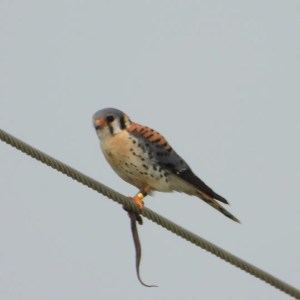
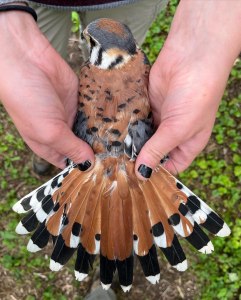 American Kestrels (Falco sparverius) are a widespread raptor in North America and are our smallest and most colorful falcon. Females sport stark black and orange striping all along the back, wings, and tail with vertical orange-brown streaks on the breast. Males have vivid blue wings and sharper orange coloration overall, with black spotting on the breast and sides. In addition to stand-out colors, kestrels have a “false eyespot” on the back of their head and dark double-facial marks that are unique among falcons. In flight kestrels are small bodied with a relatively long, thin tail. They fly on sharply pointed with quick wingbeats over open habitat searching for prey.
Habitat & Diet
Kestrels can be found in open areas such as grasslands, prairies, and farm fields. In these open habitats, they are commonly seen perched on utility pole wires where they scan the open horizon for their next meal. They have a varied diet, ranging from insects and other invertebrates to reptiles and amphibians to small mammals and birds. In this regard, kestrels serve as an effective and free natural pest control, helping farmers keep numbers of harmful insects and rodent populations low without the use of chemicals.
Kestrels are cavity nesters. In these open habitats they look for trees with a hollow, like an abandoned woodpecker excavation or a hole left by a broken branch, in which to lay eggs. Clutch sizes can vary, but females typically lay 4-5 eggs each season that are a creamy brown in color with reddish mottling.
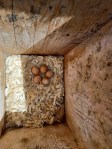
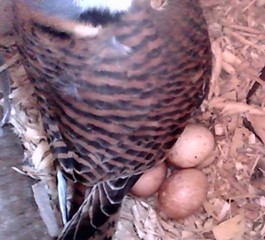
Kestrels readily use human-made nest boxes, making observations of this species’ reproduction relatively quick and easy. Interested in putting up a box, click here!
Project Goals
Nest Boxes
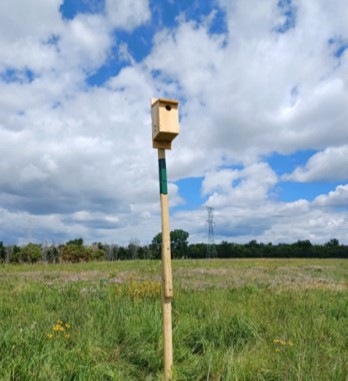
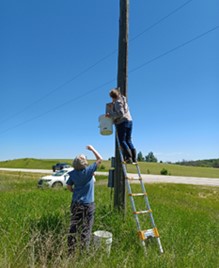
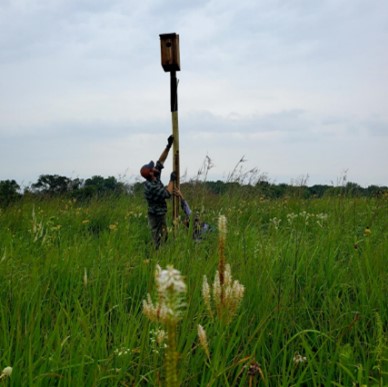
While kestrels remain the most commonly observed falcon, recent data from Christmas Bird Counts, Breeding Bird Surveys, the Raptor Population Index, and nationwide nest box monitoring programs show this species is declining in many parts of its range. This is likely linked to a lack of nesting sites. CGORS is working with local, state, and national nest box programs to help reverse this trend. We currently maintain a nest box network of about 70 boxes across 8 Wisconsin counties. For each box we track occupancy, number of nestlings fledged, adult return rates, and juvenile dispersal as well as study wintering habitat use in eastern Wisconsin. Understanding these relationships will enable a more complete picture of kestrel life history.
Banding
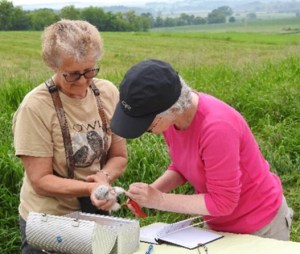 The benefits of banding birds are numerous and offers a wealth of difficult-to-obtain information. American kestrels are highly tolerant to human disturbances during nesting, making them an ideal species to work with. As trained and permitted bird banders, we give each bird an individualized numbered metal band that allows researchers to track individual movements and nesting habits over time. We also take measurements of each bird’s age, weight, and health. In addition to a metal band, we add plastic color leg bands to identify individuals in the field without having to recapture them. Resighting these unique identifiers enables us to track individual movements and survival throughout the breeding or wintering seasons.
Sample Collection
 During the banding process we also collect small tissue samples for laboratory analysis. Every sample is invaluable and we take no more than is needed. For instance, breast and back feather samples are used to study the impacts of climate change on nestling development and prey availability, while blood sampling allows for agricultural contaminants testing. All through this process, we use scientifically recognized best practices while catching and handling these birds to ensure both their and bander safety. These resilient birds of prey are unphased by these short disruptions and resume their day as soon as we leave.
Collaboration
This project is fortunate to partner with The Peregrine Fund’s American Kestrel Partnership, the Upper Midwest Kestrel Project at the University Minnesota-Duluth, Hawk Mountain Sanctuary, and the Central Wisconsin Kestrel Research group. Several local conservation organizations also give support by allowing us to build boxes on properties with suitable habitat. By working with these collaborators, scientists are able to answer research questions on a much larger scale, ensuring our work helps kestrel conservation across Wisconsin and beyond. We are always open to further collaborations and ways to contribute our data with partners!
Get Involved
There are many ways you can get involved in our work!
Build a Nest Box
Constructing and actively monitoring your own kestrel nest box is a fun, thrilling, and easy way for everyone of all ages to contribute towards kestrel conservation! Kestrels readily move into new nest boxes in suitable habitat.
- Buy or build a nest box (download instructions here) and fill with 1-3” of non-toxic wood shavings for bedding (like aspen or other hardwood)
- Mount your box 8-30 feet high (ideally 10) near open habitat facing southeast.
- Check your box at least twice each season: at minimum, once when there are eggs, and again within 30 days.
- Share observations about your kestrels on the AKP website.
- Clean your nest box every winter and replace with fresh bedding before spring migration.
If you decide to install and maintain your own nest box in our study area, contact us at the email link below and we can band those kestrels with you!
Know before you go…
“Can’t I just put out a box? Won’t that help kestrels?”
Not necessarily! It’s easy to unknowingly place a kestrel box too close to heavy road noise, expose to outdoor cats and other predators, or other sources of stress. Research has shown that these boxes produce fewer nestlings than other nearby kestrel nests. This means that installing these “bad boxes” actually hurts the local kestrel population! Monitoring allows “bad boxes” to be identified and relocated. Please, only install a kestrel nest box if you intend to monitor it and check them for breeding activity.
Reach out!
Danny is eager to speak to bird groups, birding clubs, or classes about these incredible birds if within 2 hours of Sheboygan or Milwaukee.
You can also contact Danny to learn more about what we do, report sightings of color banded birds, learn how to start monitoring your own boxes, and support kestrel research through donations to ensure kestrels remain strong in Wisconsin!
 Cedar Grove Ornithological Research Station